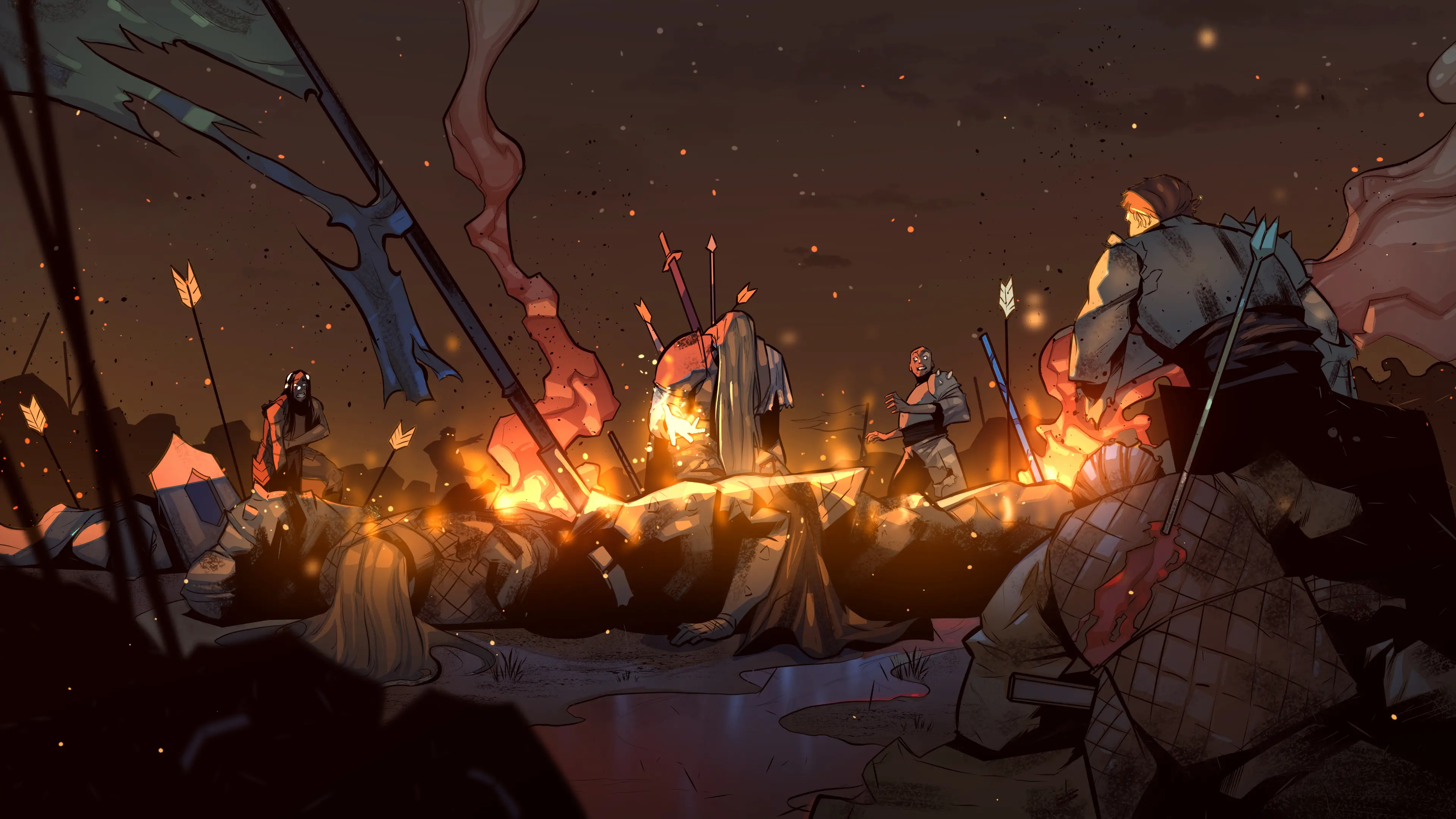
I am 10, maybe 15 steps in when I finally admit that I’ve made a serious mistake. The darkness swallows me whole, almost like a living, breathing entity. It presses down on me from all sides, and I immediately start regretting my foolishness. What's worse than the fact that I can’t even see my own nose is that I can’t tell what direction I’m facing or where I’m heading. I turn a full 360 degrees to head back in the direction I came, but there is no door—just darkness.
“Sami, you fool,” I murmur under my breath as I try to find my bearings. But it’s no use; it’s like trying to swim in dark waters at night while blindfolded. So, I do the next best thing: I try to pinpoint the sound of the child crying. After a few heartbeats, I hear it again, somewhere to my left. But that’s not all I hear.
I immediately crouch, my knife at the ready, all my senses strained. I am not alone in the darkness; I can hear shuffling all around me. At the Rose Garden, we were taught about sensory deprivation, and I try to recall that particular lesson. The sounds don’t come any closer, but they don’t get any further away either. I decide to follow the sound that got me into this mess in the first place.
I turn towards my left and set off at a slow jog, my ears primed for trouble and my knife clutched tightly in my hand. It’s harder to pin down a moving target, and even though I don’t know exactly where I’m heading, at least I’m mobile. The child’s cries have stopped, but I keep pushing. The shuffling sounds are louder now, so I increase my speed and— slam face-first into the metal side of a shipping container.
The force of the impact leaves me staggered, and I fall backward, clutching my face. What the hell? My face feels exactly like how getting smashed against unyielding metal would feel. It takes me a second to realize—I can see! The night sky has never looked more beautiful to me; the stars glisten like stationary fireflies, and a cold breeze caresses my face.
I take stock of my surroundings. Shipping containers are stacked everywhere, and the salty tang in the air tells me I am in some sort of shipping yard memoryscape. I stare at my surroundings in blank shock. From the markings on the containers, I gather that I’m in a seaport in Greece? The door must have been some sort of bridge, linking different memoryscapes, which should be impossible. But what the actual hell!
There’s no doorway, no sign of whatever brought me here. From all appearances, I just appeared out of thin air, which is bonkers!
“Cato,” I whisper urgently into my comms. “Jonas… Chani…”
There’s no response, not even static – which means I’m on my own. Nobody is coming to save me—at least, not anytime soon. My tether connection is still active, though, so it shouldn’t be too hard for THENA to track me down. I hope.
Whatever the case, I can’t just sit on my hands and wait to be rescued. I still need to find the kid, and I have no idea how many unfamiliars are lurking around this memoryscape.
After making a third turn and still not seeing a way out of this shipping container labyrinth, I realize I need to get to high ground. I pull myself up the side of a container, leap for another that is stacked three containers high, and suddenly I have a clear view of my situation. The shipping yard stretches across a brightly lit wharf. Empty ships bob in the swell of the sea, and besides the sound of groaning metal and the occasional splash of waves, the night is totally silent. It’s also empty, which is unnerving, because the containers, combined with the lights, create a patchwork of light and deep shadow.
I quickly plot my way through this metal maze towards a gate that looks locked from this distance. Past the gate, a small building sits in a brightly lit parking lot featuring a few parked cars. The building is dark and appears unoccupied, but it’s definitely better than being outside, exposed to whatever lurks around this memoryscape. Plus, where the hell is everybody?
I am about to jump down when I finally see the child.
If I wasn't paying attention, I might have missed the sharp flicker of color in an otherwise shadowy corner of the yard. Just beside one of the triple-stacked shipping containers, a small figure crouches in the shadows, occasionally peeking out to scan the surroundings. Then, like a little blur of color, the child darts from the shadows into another clump of darkness. I watch the child repeat this for a minute before leaping from my perch onto a nearby container, landing so softly that I barely make a sound.
I make my way nimbly toward where I last spotted the child, leaping from container to container noiselessly. I try to keep track of the little bugger, but the child is quick, and twice I lose sight of him, having to wait before I can pick up his trail again. Finally, I spot the child running into a patch of shadows nearby, and I drop down on the other side, reasoning that it would be much better to approach from behind and take him unawares. It will be easier to capture him that way. I’m sure Blackrose will overlook my performance today if I return with proof of a statistical impossibility.
Crouching and keeping my eye on the patch of shadow, I move closer, feeling excited despite myself. I am close enough to see the child’s outline—a small frame crouched with muscles tensed like a bird about to take flight. I take a deep breath to steady myself and then grab the kid.
“Hey!” I start to say...
It feels like I’ve grabbed the tail of an angry mountain lion. The child cries out and lashes out at me viciously, catching me on the lip and knocking me back a step. But I hold on despite the explosion of pain in my mouth.
“Hey! Stop,” I say, trying to keep my voice calm and friendly. “I’m not going to hurt you.”
That doesn’t seem to help at all, as the kid then proceeds to bite my arm. And you know kids have wickedly sharp teeth. I yell in pain and smack the kid on the head, admittedly harder than I should have.
What? Has a rabid kid ever tried to take a chunk out of you? That is no joke, and it really hurts. My smack must have knocked the kid out because he lets go of my arm and stops screaming. His head lolls to one side and I catch him as he slips to the ground.
I quickly get a firmer grip on him, making sure he can’t cause any more damage. As I do, my eyes take in some painfully obvious details: the child is a boy of maybe ten years old, with a mop of very dirty, ragged strawberry-blond hair, a dirt-smudged face, and almost black circles under each stormy gray eye. He is dressed in an equally ragged shirt and shorts. His hands and feet are dirty, the nails on each hand broken and blackened, and the soles of his feet are the same.
This kid looks like he has been through hell.
I sit on my haunches and wait for the boy to regain consciousness. As he stirs, I make sure to sit in plain sight and raise my empty hands in a non-threatening fashion. The boy slowly sits up and looks around in confusion. When he spots me, he quickly scrambles away until his back connects with the container. I don’t move, trying to convey as much non-threatening energy as I can.
“Hey, I’m sorry about that,” I say. “You know, knocking you out and all. I had to—”
The boy just stares at me as if I’m sporting two heads. I sigh and lower my hands. “You look like you’ve been having a pretty crappy time, kid.” I gesture at his clothes and his face. Then I make the universal gesture for "mess."
The boy doesn’t laugh, but he doesn’t attack me again. Instead, he looks at me half curiously, half terrified.
“Do you have a name?” I ask.
The boy tilts his head at me like a little bird. Then suddenly, his head whips to the side, and his eyes widen with renewed terror. Before I can say anything, he scrambles to his feet and dashes away.
“Ahhh shit,” I murmur.